
Signs Your Dog Is Anxious and What to Do About It
Dogs cannot tell us when they are worried, scared or overwhelmed. Instead they communicate through body language and behavior — and most owners miss the early signs completely. As a former military veterinary technician I learned to read dog anxiety signals across hundreds of animals. Here is what to look for and exactly what to do.
Why Dog Anxiety Is More Common Than You Think
Anxiety in dogs is extremely common — studies suggest that up to 72% of dogs exhibit some form of anxiety-related behavior. Yet because many signs are subtle or easily dismissed as personality quirks, anxiety often goes unrecognized and untreated for years.
Untreated anxiety does not just make your dog unhappy. Over time chronic stress can weaken the immune system, cause digestive problems, lead to compulsive behaviors and significantly reduce your dog's quality of life. Recognizing and addressing anxiety early makes a real difference.
The Most Common Types of Dog Anxiety
Separation Anxiety
The most common form. Dogs with separation anxiety become extremely distressed when left alone — or even when they anticipate being left alone. This is not your dog being dramatic or spiteful. It is a genuine stress response that can be debilitating.
Noise Anxiety
Thunderstorms, fireworks, construction, loud vehicles. Noise anxiety can range from mild discomfort to full panic attacks. Some dogs develop noise anxiety gradually as they age.
Social Anxiety
Fear of strangers, unfamiliar dogs, crowded places or new environments. Often develops from insufficient socialization as a puppy or from a negative experience.
Generalized Anxiety
Some dogs are anxious most of the time without a specific identifiable trigger. This is often genetic in nature and may require veterinary intervention.
Signs Your Dog May Be Anxious
Anxiety in dogs shows up on a spectrum from subtle early signals to obvious distress. Learning to recognize the early signals allows you to help your dog before they reach the point of panic.
Subtle Early Signs — Easy to Miss
Yawning When Not Tired
Yawning is a calming signal in dogs — a way of communicating stress or discomfort. If your dog yawns repeatedly in situations that are new or uncomfortable they are telling you they feel uneasy.
Lip Licking With No Food Present
A quick tongue flick across the lips when there is no food around is another calming signal. Watch for this during vet visits, new introductions or busy environments.
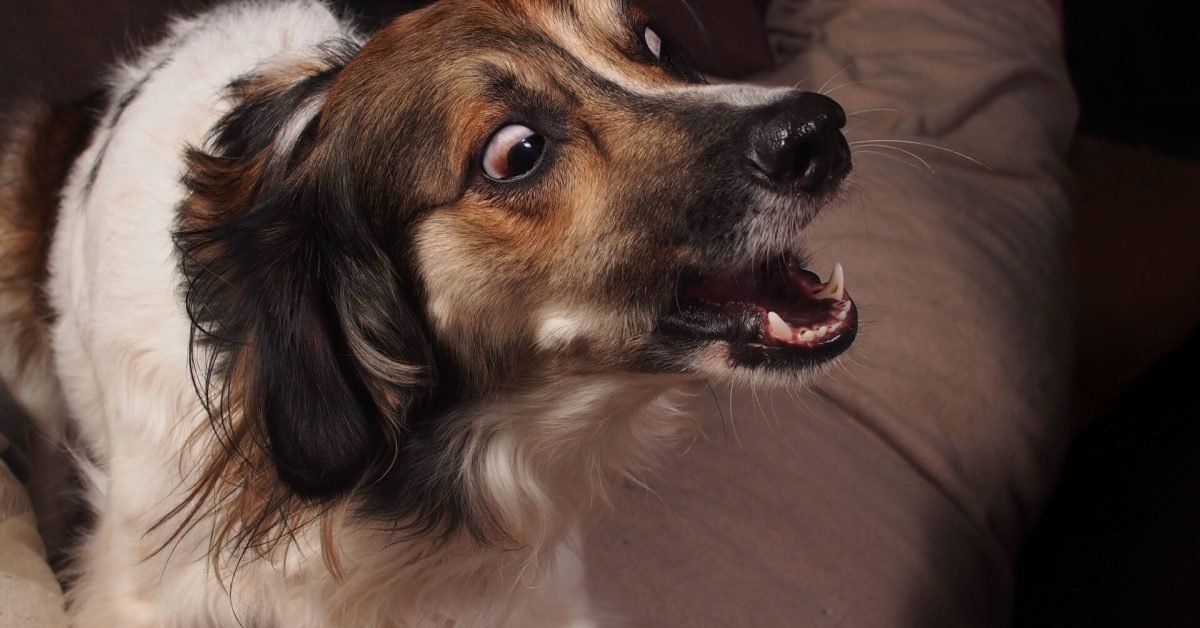
Whale Eye
When you can see the white of your dog's eye — the sclera — more than usual, your dog is stressed. They are keeping their head still while moving their eyes to track something that is making them uncomfortable.
Turning Away or Avoiding Eye Contact
A dog who turns their head away, looks at the ground or moves their body away from something is using displacement behavior to signal they want distance from whatever is stressing them.
Ears Pinned Back
Ears pulled flat or back against the head indicate fear or anxiety. Combined with a lowered body posture this is a clear stress signal.
More Obvious Signs
Panting Without Heat or Exercise
Stress panting looks the same as heat panting — rapid open-mouth breathing — but happens when the dog is not hot and has not been exercising. If your dog is panting in an air-conditioned room during a thunderstorm that is anxiety panting.
Pacing and Restlessness
Unable to settle, walking back and forth, unable to lie down for more than a few seconds. This is a classic sign of moderate to high anxiety.
Excessive Barking or Whining
Vocalization that seems out of proportion to the situation — particularly barking or whining when left alone — often indicates anxiety rather than boredom or attention-seeking.
Destructive Behavior
Chewing furniture, scratching doors, destroying items — especially when left alone — is a classic sign of separation anxiety. Dogs are not being spiteful. They are self-soothing through a stress response.
Toileting Indoors Despite Being Housetrained
A housetrained dog who suddenly has accidents indoors — particularly when left alone — may be experiencing separation anxiety. The stress response overrides their normal bladder control.
Hiding or Seeking Constant Closeness
Some anxious dogs hide — under beds, in closets, behind furniture. Others become velcro dogs who cannot be more than a foot from their owner at any time. Both are anxiety responses — just in opposite directions.
Trembling or Shaking
Visible trembling when not cold is a sign of significant fear or anxiety. Common during storms, fireworks, vet visits and other high-stress situations.
What You Can Do to Help
Create a Safe Space
Give your dog a dedicated quiet area where they can retreat when overwhelmed. A covered crate, a corner with their bed and a familiar blanket works well. Never force your dog out of their safe space when they have chosen to go there. That space needs to always feel safe.
Stay Calm Yourself
Dogs are exquisitely sensitive to human emotional states. If you become anxious or stressed when your dog is anxious — rushing to comfort them in a panicked way — you confirm that there is something to be worried about. Calm, matter-of-fact reassurance works better than dramatic comfort.
Counterconditioning
Pair whatever triggers anxiety with something your dog loves. If your dog is anxious during thunderstorms play with their favorite toy or give high-value treats during the storm. Over time the brain begins to associate the trigger with something positive rather than something frightening.
Desensitization
Gradually expose your dog to their anxiety trigger at very low intensity — far away, very quiet — while keeping them under their stress threshold. Slowly increase the intensity over many sessions. This works especially well for noise anxiety and social anxiety.
Exercise and Mental Stimulation
A well-exercised dog has lower baseline anxiety. Daily exercise appropriate for your dog's age and breed — combined with mental stimulation through training, nose work and puzzle toys — significantly reduces anxiety levels over time.
Calming Products
Thundershirts and anxiety wraps apply gentle constant pressure that many dogs find calming. Adaptil diffusers release synthetic calming pheromones. Calming supplements containing ingredients like L-theanine, melatonin or chamomile are available over the counter. Results vary by dog — discuss with your vet before starting any supplement.
Never punish an anxious dog for anxiety-related behavior. Punishment increases stress and makes anxiety worse — not better. Destruction during separation anxiety is not defiance. Trembling during a storm is not stubbornness. These are stress responses. They need understanding and help, not correction.
Learn more about your dog's body language and what it means.
Read the Dog Body Language Guide →